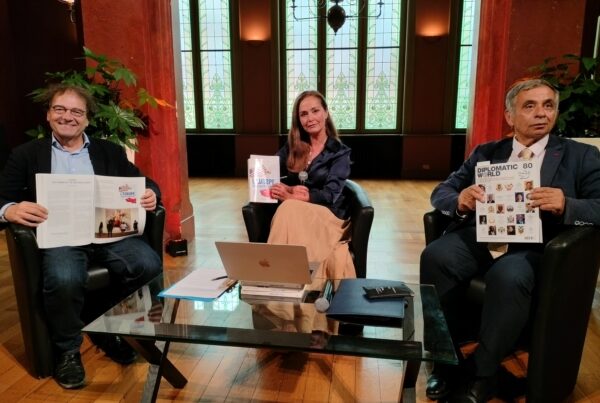
Palacio de Cibeles

H.M. King Felipe VI of Spain with Members of Club de Madrid
Madrid, Palacio de Cibeles – Club de Madrid 23 June 2026 – H.M. King Felipe VI of Spain opens by expressing honor and gratitude toward the assembled group, highlighting the 25-year legacy of the Club of Madrid, a body composed of seasoned democratic leaders with valuable real-world governance experience. Emphasising that such leadership and vision are honed over time rather than taught in classrooms, the speaker acknowledges the sustained contributions of members and founders who have shaped this distinguished institution.
The Club’s value lies in its capacity for calm, unbiased analysis and its alignment with democratic ideals, symbolised by its association with Spain’s capital, a city representing openness and hospitality.

Mayor of Madrid

H.M. King Felipe VI of Spain with Barbara Dietrich (DW Institute)
Challenges Of Global Governance And The Fragility Of Interdependence
The speech transitions into the current state of the international order, reflecting on past hardships like two world wars and the fragile global peace they helped shape. The present moment is described as a crossroads where the paradox of our interconnected world becomes evident: “dependence among nations is at an alltime high, yet there is increasing temptation for isolation and nationalism”. This is a critical challenge, as no single state can solve global problems alone. H.M. King Felipe VI of Spain underlines that the focus must shift to “how to build trust and responsibly govern this interdependence” amid fast technological developments and economic shifts. There is concern over the rise of aggressive pragmatism that prioritises material success over democratic participation and rights, endangering fragile systems of balance and transparency. Nonetheless, H.M. King Felipe VI of Spain affirms belief in the possibility of building a more free, responsible, and cooperative world that promotes dignity, hope, and inclusive scientific and cultural development.
The Concept And Importance Of Global Public Goods
A key theme is the necessity of protecting “global public goods”, including climate stability, health security, ocean conservation, food security, and a safe digital environment. These goods require international cooperation, even among parties with conflicting interests, since their preservation benefits all and their deterioration affects everyone. Protecting these goods is framed not only as a moral duty but as a rational, pragmatic choice:
- The “costs of inaction” lead to greater conflict, health crises, climate instability, and economic collapse, far outweighing preventive investments.
- Spain’s multilateral policy strategy for sustainable development, launched recently, exemplifies commitment to this global agenda.
The need for genuine, inclusive international consensus is stressed, alongside the recognition that global instruments and frameworks are currently strained but still capable of achieving agreements through trust and shared values..

The Role Of Democracy And Shared Values In International Cooperation
H.M. King Felipe VI of Spain highlights the unique capacity of democratic systems to foster participation rooted in “recognition of human dignity and the individual as the centre of governance.” This democratic ethos underpins the legitimacy of the international community and its ability to reach universal agreements. Citing philosophical reflections on civilisation as a “will to coexist,” the speech urges continued faith in democracy’s role as a generator of consensus and cooperation amid complex global challenges. Finally, H.M. King Felipe VI of Spain calls on members of the Club of Madrid, especially its women leaders, to continue lending their time, expertise, and wisdom to support this vital mission of guarding global democracy and cooperation, characterised as an invaluable service to the global community.
Overall Conclusion
This address underscores the enduring significance of democratic leadership and collective governance in sustaining a global order capable of managing shared challenges. It calls for renewed commitment to multilateral cooperation to protect global public goods and promote a just, inclusive international community grounded in democratic values and solidarity.

Club de Madrid is an independent international organisation composed of former democratic presidents and prime ministers from around the world. It was established in 2001 to promote democracy, good governance, and inclusive leadership. The organisation works by sharing the experience of former leaders to address global challenges. It supports democratic institutions, human rights, and sustainable development. Today, Club de Madrid is recognised as one of the world’s largest forums of former democratic heads of state and government. (www.clubmadrid.org/ )