Ziyad Alquwaizani, Managing Partner, NORM
BEYOND THE OLD LENS
SAUDI ARABIA, EUROPE, AND THE FUTURE OF STRATEGIC UNDERSTANDING
Ziyad Alquwaizani, Managing Partner, NORM
Saudi Arabia is not asking to be romanticised. It is asking, through its transformation, to be understood in full: as a society with roots, a state with direction, an economy with scale, and a partner with a role in global stability.
There are moments in life when the path in front of you is respectable, clear, and even admired by others — yet something within you remains unsettled.
For me, that path was medicine. It was a noble field, and I never looked at it with anything but respect. Yet, even as I moved through that world, I felt that my purpose was pulling me somewhere else. I was not searching for attention, nor for a title. I was searching for a place where I could serve something larger than myself: my country, its story, and the truth of what it has always been.
For many years, what troubled me most was not that Saudi Arabia was criticised. Criticism, when honest, can be useful. What troubled me was that my country was often reduced to a narrow image, a frame built from fragments, repeated headlines, and old assumptions. The Saudi Arabia I knew
was not the Saudi Arabia many people abroad thought they understood.
I knew a country of families, generosity, ambition, faith, dignity, and deep social bonds. I knew a people who were not waiting to be reinvented by the world, but waiting for the right moment to show the world who they had always been.
That is why Vision 2030 matters to me not only as an economic program, but as a national moment. Under the leadership of the Custodian of the Two Holy Mosques King Salman bin Abdulaziz, and through the vision and drive of His Royal Highness Crown Prince Mohammed bin Salman, Saudi Arabia did not abandon its essence. It did not become a different country. Rather, it became more visible, more confident, and more capable of expressing itself.
Vision 2030 did not create Saudi ambition from nothing. That ambition was already there, in our young people, in our families, in our entrepreneurs, in our institutions, and in the quiet belief that this country was built for more. What the Vision did was give that ambition direction, structure, and permission to move.
The transformation taking place in the Kingdom is often described through numbers, projects, and economic indicators. Those are important. Saudi Arabia’s non-oil economy has become one of the clearest indicators that the transformation is moving from vision into economic reality; Reuters
reported that Saudi non-oil activities grew 4.3 percent in 2024, even as the broader economy was still affected by oil-market dynamics. But numbers alone do not explain the emotional and social energy that has been released inside the country.
The real story is not only that Saudi Arabia is building new sectors. It is that Saudi citizens now see themselves as active participants in a national rise.
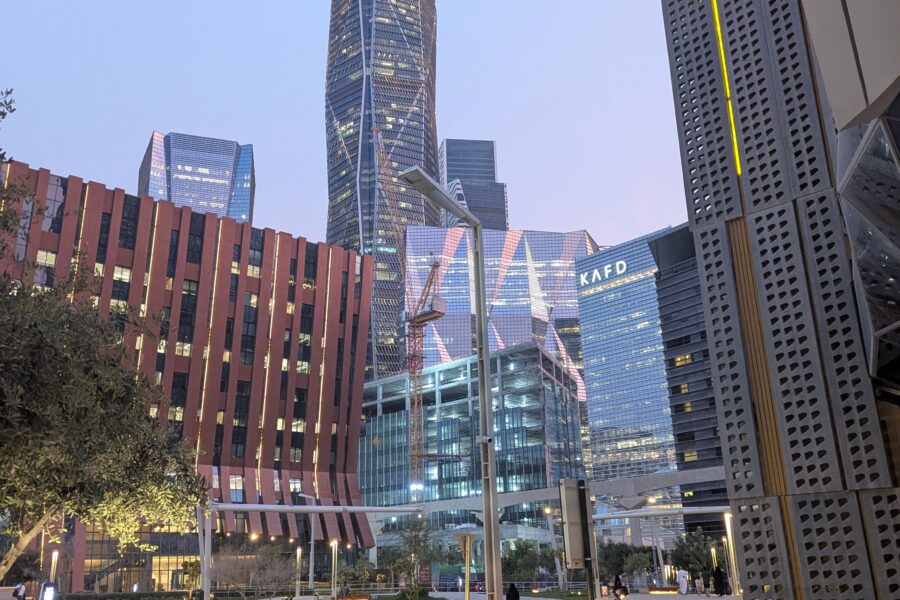
This is why sports, tourism, culture, entertainment, technology, and major global events should not be viewed as cosmetic changes. They are windows. They allow the world to see what was often hidden behind outdated narratives. A visitor to Riyadh, Jeddah, AlUla, Diriyah, or the Red Sea does not only see infrastructure. They meet Saudis. They encounter hospitality. They see a society that is rooted, but moving. Traditional, but not stagnant. Proud, but not closed.
Perhaps one of the most interesting effects of this new openness is that Saudi Arabia is no longer being understood only through official delegations or political reports. It is being understood through lived experience.
When Cristiano Ronaldo said, “I belong to Saudi Arabia,” and added that the country had welcomed him, his family, and his friends, the importance was not in the fame of the speaker, but in the simplicity of the testimony. He was speaking not only as an athlete, but as someone whose family,
business, and daily life had become connected to the Kingdom.
The same idea appears, in a different form, in the words of Scottish explorer and former BBC presenter Alice Morrison, who set out to cross Saudi Arabia from north to south on foot. “Saudi Arabia has welcomed me,” she said, while describing a country that supported and encouraged her exploration. Her words matter because they do not come from a boardroom or a stadium, but from
someone walking through the country, meeting its people, and challenging inherited assumptions directly.
In culture, the Red Sea International Film Festival in Jeddah offered another striking moment. Looking at the scale and energy of the festival, one visiting film-maker said: “I have never seen anything like this. Not at Cannes, not anywhere.” That statement is not only praise for an event; it is
a sign that Saudi Arabia’s cultural opening is no longer peripheral. It is becoming part of the global conversation.
These are not political slogans. They are lived impressions. One reflects belonging, another reflects discovery, and the third reflects cultural surprise. Together, they show that when Saudi Arabia is encountered directly, through family life, exploration, or art, the old image begins to weaken,
and a more accurate picture starts to emerge.
This distinction matters matters deeply for Europe. Europe does not need to romanticise Saudi Arabia. It needs to understand it accurately.
For too long, parts of the European conversation around the Kingdom have been shaped by distance. Distance allows stereotypes to survive. It allows old frames to harden. It allows political debates to replace human contact, and headlines to replace reality.
But the world today cannot afford lazy understanding.
Europe is facing a different century: energy uncertainty, industrial competition, demographic challenges, supply-chain vulnerabilities, climate pressure, and geopolitical fragmentation. In such a world, Saudi Arabia is not merely a country to be analysed through an old political lens. It is a strategic partner, an economic platform, a cultural bridge, and a stabilising force in a region that
directly affects European prosperity.
Recent regional tensions, especially those involving Iran and the wider security of energy routes, have reminded everyone that stability in the Gulf is not a local matter. It is a global economic necessity. When energy markets are disrupted, Europe feels it through inflation, industrial costs, household bills, and investor confidence. The European Commission has warned that conflict-driven energy shocks can slow eurozone growth and raise inflation, showing how directly Middle Eastern stability connects to European economic life.
This is where Saudi Arabia’s role becomes clearer. The Kingdom’s value is not only in what it produces, but in the balance it brings. Its decisions in energy, diplomacy, investment, and regional engagement carry consequences far beyond its borders. In difficult moments, measured leadership matters. Stability is not an abstract word; it is a condition for trade, food security, energy security, and long-term investment.
For European family offices, institutions, and strategic investors, this should be understood carefully. Saudi Arabia is not simply opening sectors for capital. It is building a long-term national platform: tourism, logistics, mining, renewable energy, Artificial Intelligence, sports, culture, healthcare, and advanced industries. Its strategic geography — connecting Asia, Africa, and Europe
— is not only a phrase in a national vision document. It is becoming a practical economic proposition.
Yet the opportunity is not only commercial. It is civilisational.
The coming chapter between Saudi Arabia and Europe should not be built only through contracts, delegations, and formal statements. It should be built through trust. And trust requires people who can translate between worlds — not linguistically, but culturally, politically, and emotionally.
That is why bridge-building matters. I believe there is a real need for bridges that help serious people see serious realities. The mission should not be to create illusions, but to uncover value where noise has covered it; to bring decision-makers, investors, institutions, and thinkers closer to
environments that are constructive, ambitious, and often misunderstood.
For me, this work is personal. It is personal because I know what it means to love a country whose image has too often been shaped by others. It is personal because I have seen how Vision 2030 gave many Saudis not only opportunities, but language, a way to express the ambition they already
carried. And it is personal because I believe the relationship between Saudi Arabia and Europe should not remain trapped between hesitation and necessity. It should move toward understanding.
Saudi Arabia is not asking the world to ignore its complexity. No serious country should. But it is asking, implicitly through its transformation, to be seen in full: as a society with roots, as a state with direction, as an economy with scale, and as a partner with a role in global stability.
The future relationship between Saudi Arabia and Europe will not be built by those who inherit old assumptions. It will be built by those willing to look again. To look beyond the old lens.
And to recognise that what is emerging in Saudi Arabia is not a performance for the world, but a national journey that the world now has the opportunity to understand, engage with, and help shape
through partnerships.