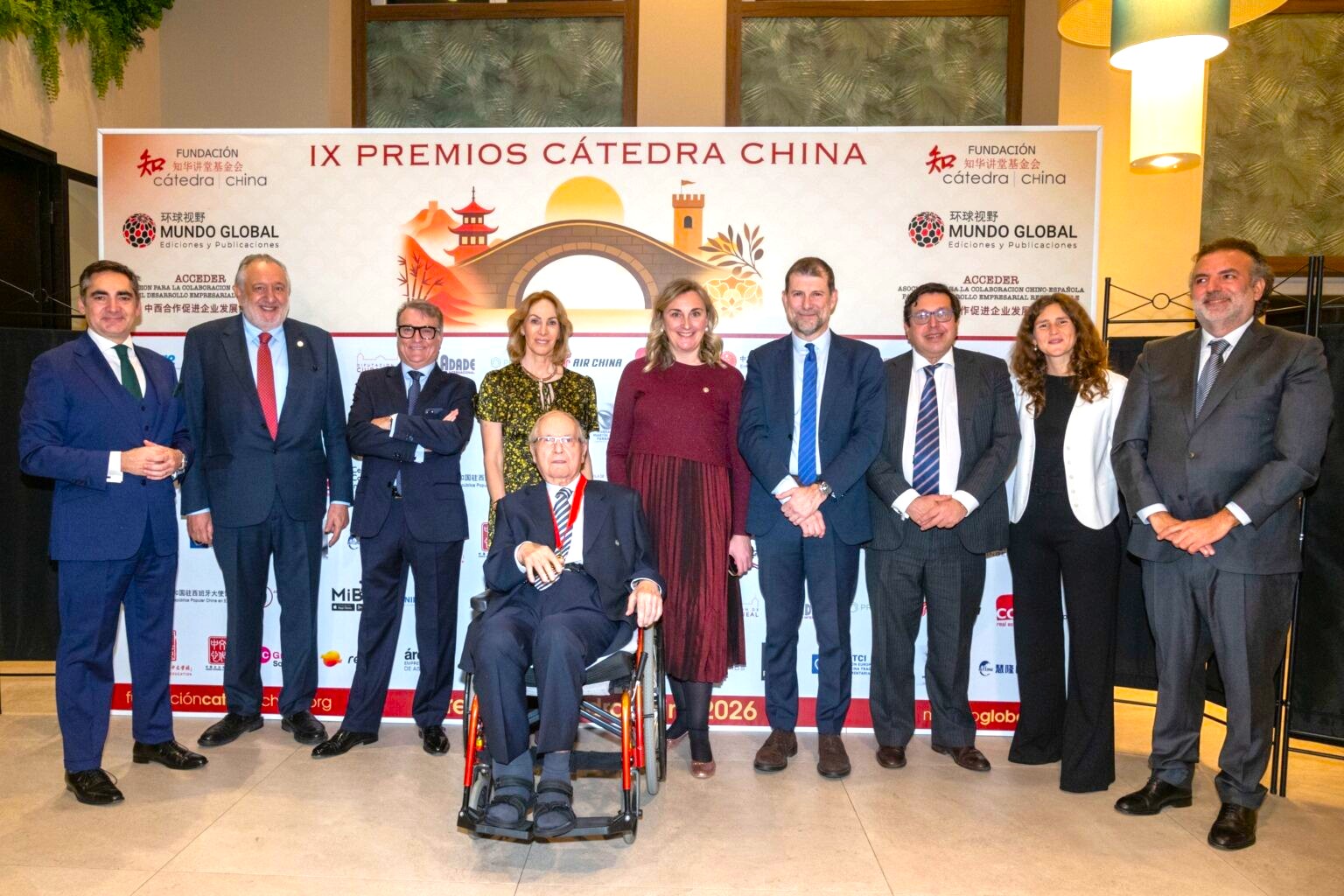
On 7 February 2026, Madrid hosted a landmark event in the framework of Spain–China relations with the celebration of the IX Cátedra China Awards Gala, organised by the Fundación Cátedra China. Held at the Hotel Riu Plaza España, the ceremony brought together representatives from diplomacy, academia, business and civil society to honour outstanding contributions that have strengthened mutual understanding and cooperation between the People’s Republic of China and the Kingdom of Spain.
The gala stood out not only for its symbolic setting in the heart of the Spanish capital, but also for the high-level profile of its attendees. Among them were the President of Cátedra China, Marcelo Muñoz, and its Director, Marta Montoro, who represented the institutional leadership behind the initiative. Their participation underscored the strategic and sustained effort required to consolidate platforms of dialogue between Spain and China, highlighting the role of Spanish professionals and institutions in fostering trust, continuity and meaningful cooperation beyond formal diplomatic channels. In his remarks during the ceremony, Chinese Ambassador to Spain, Yao Jing, highlighted exactly this point, thanking Cátedra China and especially Marcelo Muñoz “for enabling people from these two great nations to meet and communicate with one another” and stressing that the progress in bilateral relations reflects “friendship and mutual understanding rooted deeply in the hearts of both countries”. His affirmation underscored the role of interpersonal and institutional bridges in advancing long-term cooperation, even as he acknowledged the complexity of sustaining such a strategic partnership.
The IX Cátedra China Awards recognised four awardees whose trajectories illustrate the breadth and depth of Spain–China cooperation across different sectors.
In the category of Person, Dr. Diego González Rivas was honoured for his pioneering work in minimally invasive thoracic surgery and for his strong professional ties with China. His career exemplifies how scientific innovation and medical excellence can serve as powerful bridges between countries, fostering knowledge exchange and mutual trust in highly specialised fields.
The Academic Institution award was presented to the Universidad Politécnica de Valencia in recognition of its sustained commitment to internationalisation and its strategic engagement with China. Beyond traditional cooperation programmes and exchange agreements, the university has achieved a historic milestone with the inauguration of the Beihang Valencia Polytechnic Institute (BVPI) in Hangzhou, the first Spanish university campus in China to offer official, in-person university degrees abroad—a landmark achievement in the history of Spanish higher education and in the bilateral educational relationship with China.
Located in one of China’s most dynamic centres of technological innovation—often referred to as China’s Silicon Valley—this campus represents a deepening of academic ties at multiple levels. Designed to host up to 2.000 students, the institute will deliver a broad academic portfolio, including bachelor’s, master’s and doctoral programmes focused on communications, computer and artificial intelligence engineering, and aeronautical engineering, with a curriculum that integrates the strengths of both the UPV and its Chinese partner institution.
The creation of the BVPI has been underpinned by strategic agreements and shared vision, resulting in the establishment of joint research laboratories and collaborative frameworks in cutting-edge fields such as artificial intelligence and intelligent manufacturing—areas that are central to future economic and technological cooperation.
This innovative educational initiative not only broadens opportunities for student and faculty mobility but also cements the UPV’s role as a bridge between Spanish and Chinese academic ecosystems, enhancing scientific exchange and reinforcing long-term educational and cultural connections.
In the Institutional and Cultural category, the Usera Project of the Madrid City Council was acknowledged for its contribution to social cohesion and cultural dialogue. The project has played a significant role in highlighting the Chinese community in Madrid, promoting intercultural understanding and transforming Usera into a living example of coexistence and cultural exchange at the local level with international resonance.
Finally, the Business award was granted to Air China, recognising its two decades of presence in Spain and its decisive role in enhancing connectivity between the two countries. Beyond air transport, the company’s trajectory reflects the steady growth of economic, commercial and cultural exchanges, facilitating mobility for business, tourism, academia and institutional cooperation.
Strengthening EU–China Cooperation Through Presence and Partnership
The participation of the Belgian foundation Finnova in the IX Cátedra China Awards Gala was closely aligned with this collaborative vision and served as an opportunity to actively promote the involvement of Chinese and European stakeholders in European projects and programmes. Beyond its ceremonial dimension, the gala provided a valuable institutional setting to reaffirm shared objectives and to advance in the promotion of EU funded cooperation initiatives between EU and China, particularly in the fields of education, training and innovation. Finnova’s presence, presented by his CEO, Juan Manuel Revuelta, and the EU funds director, Juan Viesca, underscored its commitment to facilitating access to European funding instruments and project-development frameworks.
Finnova Foundation is a European non-profit foundation specialised in the design, development and implementation of projects funded by European Union programmes. Based in Brussels and working closely with EU institutions, Finnova supports public authorities, universities, SMEs, startups and civil society organisations in accessing and managing EU funding instruments.
The gala also counted on the participation of Nela Gomez, director of Euro FUE-UJI, the European affairs unit of the Fundación Universitat Jaume I–Empresa, reinforcing the strong link between higher education institutions and international cooperation frameworks. As the foundation is connected to the Universitat Jaume I of Castellón, FUE-UJI’s presence highlighted the growing role of universities and their affiliated entities in fostering international dialogue beyond academia, particularly in areas such as education, training, knowledge transfer and innovation. Its participation reflected a shared interest in strengthening ties with China through structured cooperation initiatives, while exploring opportunities for involvement in European projects that promote institutional capacity building, skills development and collaborative research with international partners.
A Diplomatic Gathering with a Forward-Looking Message
Beyond celebrating individual achievements, the gala served as a platform for reflection on the present and future of Spain–China relations. The diversity of the awardees—from medicine and higher education to urban culture and global business—sent a clear message about the comprehensive and evolving nature of bilateral cooperation.
As highlighted in the exclusive interviews published in Mundo Global, the magazine of Fundación Cátedra China, the voices of the awardees converged on a shared vision: the relationship between Spain and China is no longer confined to traditional diplomacy, but is increasingly built through innovation, people-to-people exchanges, academic excellence and sustainable economic ties.
The IX Cátedra China Awards Gala thus reaffirmed Madrid’s role as a key meeting point for dialogue between Europe and China. More than a ceremonial event, it stood as a diplomatic and cultural milestone, reinforcing confidence in cooperation as a strategic tool for navigating an interconnected and rapidly changing world.